It is 6:40pm on a Friday in July. A homeowner in Phoenix comes home to a house at 91 degrees and an AC blowing warm air. They call your shop. The office closed at five, but the call gets answered: someone takes the address, the callback number and what the unit is doing, and offers Saturday morning.
Most writing about HVAC customer experience stops there, at the answered call. It shouldn't. At 7am on Saturday you have that call and eight more like it, and what happens in the next hour decides whether they become jobs. The customer experience gets won or lost on the callback.
Why the overnight list matters more than it looks
CallRail's 2025 data found that 34% of calls to businesses arrive after hours, and that after-hours callers are 24% more likely to book than daytime callers. Invoca's 2025 research found that 39% of phone leads never reach a person at all.
So the calls on your overnight list come from the people most ready to buy. They are also the people most likely to keep dialing. A homeowner who called you at 6:40pm and heard nothing by 9am Saturday has probably called two other shops too. Answering the call buys you some time, and the callback decides what you do with it.
Read the whole list before you dial anyone
The common mistake is calling back in the order the calls came in. The 9:15pm tune-up request gets a callback before the 11pm no-heat call because it was earlier on the list.
Take five minutes and read every call first. Then sort them into three piles:
- Can't wait: no cooling in a heat wave, no heat on a freezing night, water coming through a ceiling, or anyone in the house who is elderly, very young or unwell. These get the first callbacks.
- Booked: callers who already chose a day and now need a confirmed time.
- Everything else: price questions, quotes, "call me about a new system," and the calls that were really for a plumber.
Which pile a call goes in is your decision, and you can only make it from what the caller actually said. "AC not cooling" could be either pile. "AC blowing warm, 91 inside, my mom is 84" is not. That is why a full transcript beats a two-line message here. Our post on emergency calls versus next-day scheduling goes through the signals worth looking for.
Calls that can't wait for morning
Some calls on that list should not have waited for 7am at all. Whether they do comes down to your own after-hours routine: who looks at evening calls, and when.
If you use Thermoi, you can have an email or a Slack message sent after every call ends. Both are off until you turn them on. Point that Slack channel at whoever is on call, and the evening calls reach a person while the evening is still going. Writing down who that person is each week, and what they do with a no-heat call at 11pm, is covered in our peak season preparation post. Most shops have never written it down.
The callback that keeps the customer
The customer already told the whole story once. The worst callback opens with "So what seems to be the problem?" The best one opens with what they said:
"Hi, this is Mike at [your shop]. You called last night about the upstairs unit blowing warm air, with your mom staying with you. I can have someone there between 9 and 11 this morning. Are you still at the house on Cactus Road?"
That callback does four things in two sentences. It proves someone read the call. It gives a window you can actually keep. It checks the address before a tech drives to the wrong house. And it never makes the homeowner repeat themselves at 7am after a night in a hot house.
If you charge a diagnostic or after-hours fee, say so on this call, not at the door. A price heard on the phone is a decision. A price first heard on the porch can turn into a bad review.
Confirming the bookings that are already made
When Sara takes a booking, she takes the day and whether the caller wants morning or afternoon, and reads it back to them. She cannot see your calendar, so she does not give a time. That part is yours, and the earlier you do it, the less chance the customer has to keep shopping.
A one-line confirmation by phone or text from your shop is enough: "You're booked for Saturday, our tech will be there between 1 and 3." Do these right after the can't-wait pile, before the office phone starts ringing.
When you can't take the job
Some mornings there are more no-cooling calls than techs. Tell those callers the truth early: "We can't get to you before Monday. If you can't wait that long, I'd understand you calling someone else." People remember the shop that was straight with them. They remember the one that never called back too, usually in a review.
Close every call by end of day
By the end of the day, every overnight call should have an outcome you could point to:
- Booked, with a confirmed time.
- Called back and declined, with the reason.
- Called twice with no answer, then sent a text from the shop line.
- Passed on because it was out of area or not HVAC.
If a call is still open on Monday, the customer has usually decided for you.
Once a week, read for patterns
Pick a quiet half hour and read a week of transcripts in one sitting. You will notice things that no single call shows you, like the same question about maintenance plans asked six times, a neighborhood where calls cluster, callers confused by your hours. Change your greeting, your website or your hours to answer them. If it is something Sara should say differently, tell us and we change her setup.
What Thermoi covers, and what stays yours
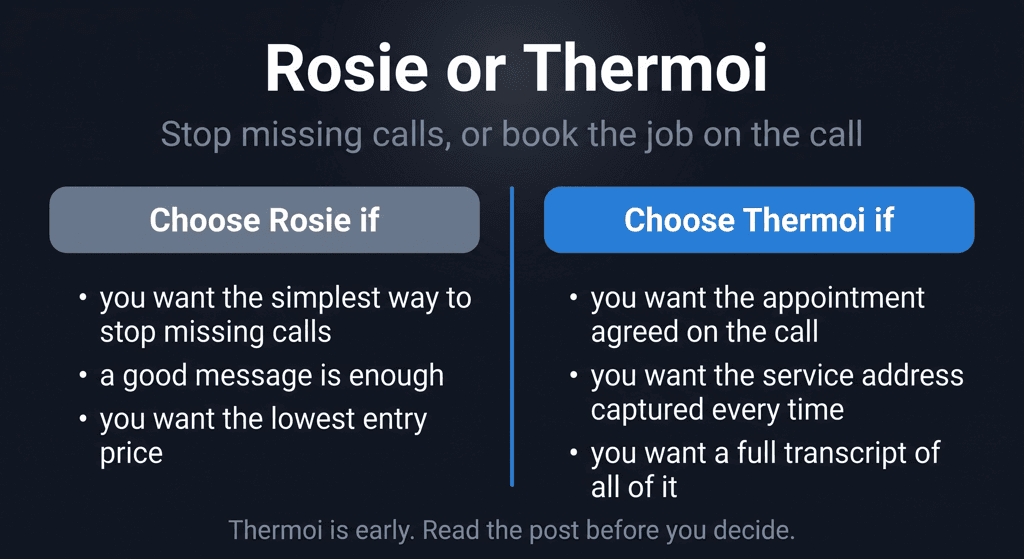
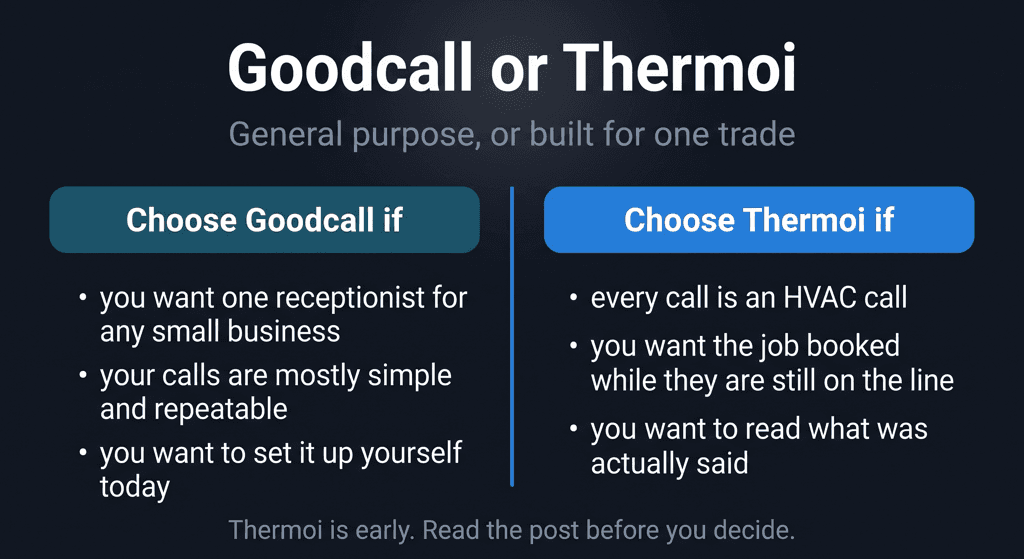
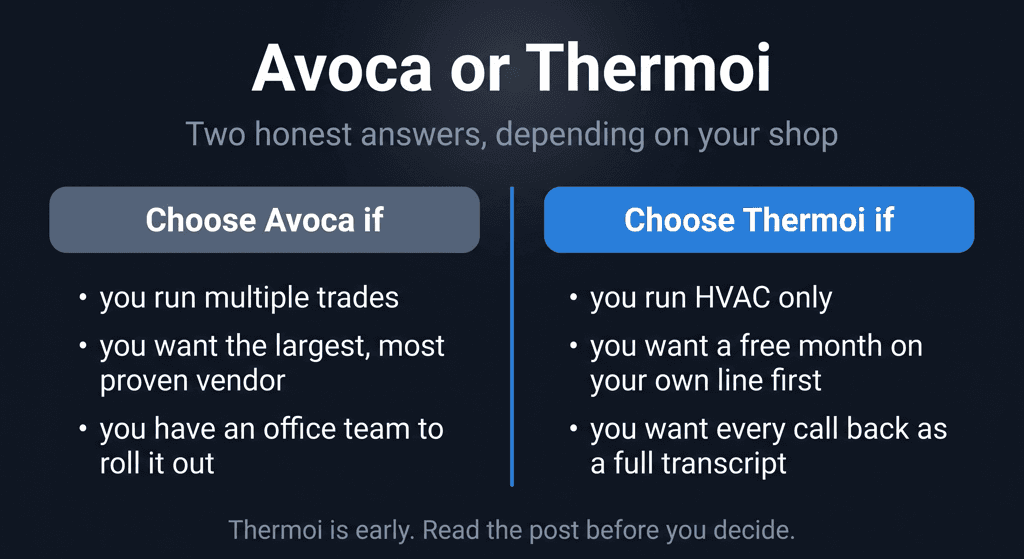
Thermoi covers the part before the callback. Sara answers in your shop's name around the clock, says she is an AI assistant, takes the caller's name, number, address and problem, and books the job when there is one. Every call comes back as a summary and full transcript in your dashboard. She does not transfer calls or decide which ones are urgent. The sorting and the callback stay with you, which is the point of this post.
See how that works for evening and weekend calls on the after-hours calls page, or the HVAC answering service overview. The first month is free for up to 40 calls, with no card and no contract. After that it is one plan: $299 a month for up to 200 calls.