Every HVAC shop makes a decision on every evening call, whether anyone has written it down or not.
A call comes in at 8pm. Someone says their air conditioning isn't working. What happens next?
Option A: they get the next open slot, tomorrow morning at 9am.
Option B: somebody reads that call the same evening, decides it will not keep until morning, and gets word to whoever is on call.
Voicemail and most answering services default to Option A for every call. It is simpler and it fills the calendar. For a fair share of calls it is also the wrong answer, and getting it wrong costs you the job.
Two kinds of HVAC call
Most calls are routine. A homeowner wants an AC tune-up before summer. Someone needs a filter changed. A landlord is booking a pre-winter heating check. The timing is flexible and the caller is calm. The job is to get them on the calendar.
Some calls are emergencies. A family's heating has failed on a cold night. An AC has stopped completely in a heat wave. An elderly homeowner is calling because the house is getting dangerously warm. These callers are not shopping for an appointment. They want to know whether anyone is going to deal with it tonight.
Treat both the same and you serve the first group well and lose the second. The emergency caller who hears "the earliest we have is Thursday" hangs up and dials the next contractor before you ever see the message.
What an emergency caller needs from the call
Someone calling with no heat at 10pm is somewhere between stressed and panicking. They are thinking about their family and whether help can come tonight.
Two things keep that caller from hanging up and trying someone else. First, they reach someone, not a beep. Second, they hear their problem taken down properly: the address, what the equipment is doing, a number to call back. A caller who has been heard and written down waits for your call. A caller who left a message on a machine keeps dialing.
What happens after that is yours. If your on-call tech calls them back within the hour with a time, the job is usually yours. If the call sits in a voicemail box until 7am, it usually is not.
The signals to look for in a call
Whoever reads the evening's calls, you or your on-call tech, can sort them quickly by looking for a few things in what the caller said.
What they said is wrong. "The AC stopped completely," "we have no heat," "the furnace just died." Those words mean a different thing than "it's not cooling as well as it used to."
When they called. A call at 9pm in a heat wave is more likely to be urgent than one at 10am on a mild Tuesday.
The weather. "Not cooling well" on a spring day is a routine booking. The same words during a Phoenix July week above 105°F may be a system about to fail.
Who is in the house. When a caller mentions an elderly parent, a baby, or someone with a medical condition that makes heat or cold dangerous, most shops treat the call as urgent however the equipment problem is described. "My mother is 82 and her heat isn't working" is one of those calls.
Whether they have called before. "I called earlier and nobody got back to me" tells you the caller is already looking elsewhere.
You can only read these signals if the call was answered and written down in the caller's own words. That is the part Sara does. She answers, takes the address, the callback number and what the equipment is doing, and the summary and full transcript come back to you when the call ends. Deciding which calls get someone tonight stays with you.
Why booking everything for the next day is expensive
Treating every call as a routine booking is tempting. It is consistent and easy to manage. The cost shows up in three places.
You lose the emergency jobs to whoever answers. These are often your best calls of the week: urgent, willing to pay for the visit, and grateful afterwards.
You leave a bad memory with the caller you let down. "Called at 10pm, they had someone out within the hour" and "told me to call back in the morning when my heat was out" can come from the same shop on the same night, depending on how the call was handled.
You miss the relationship. A homeowner whose emergency you handled well tends to stay: the maintenance plan, the replacement system in a few years, the neighbour you get recommended to. None of that follows if they booked someone else.
Who makes the call
Getting this right every night takes either a well-trained person available at all hours or a clear routine for reading the evening's calls. Most small shops do not have the first, so the second is where to start.
Software can make sure the call is answered and that what the caller said is written down accurately. Deciding what counts as an emergency for your shop, and who goes out tonight, is a judgement about your crew, your week and your customers. That decision stays with you, and it is easier to make well when you are reading the whole call instead of a nine-second voicemail.
Putting it into practice
If your after-hours calls currently go to voicemail or a basic answering service, the change does not mean rebuilding your operation. It takes two pieces: something that answers the call and writes it down instead of losing it, and an on-call routine on your side that reads the calls and calls back quickly. An answered call does not help if nobody reads it until morning, so both pieces matter. Our post on working the overnight call list the next morning covers the second piece in detail.
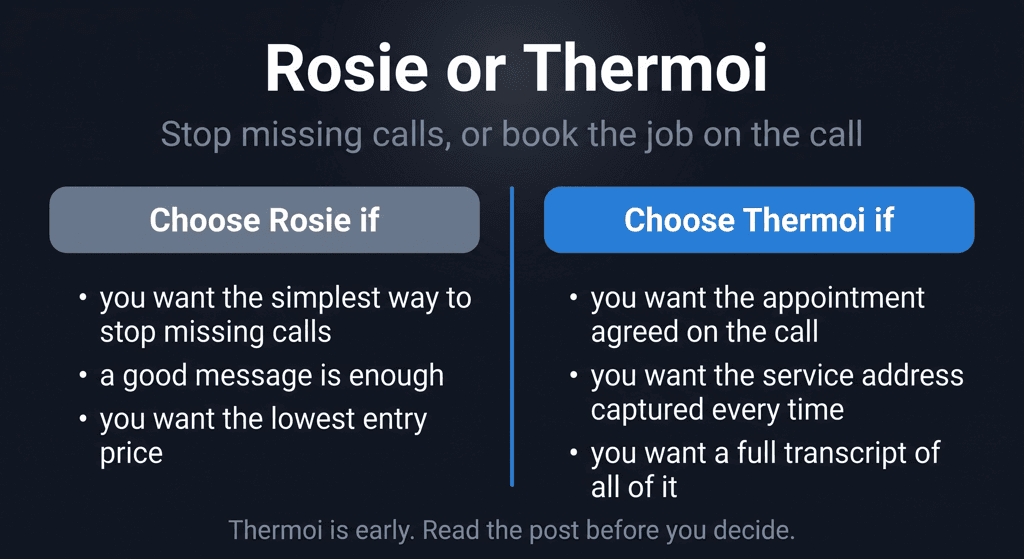
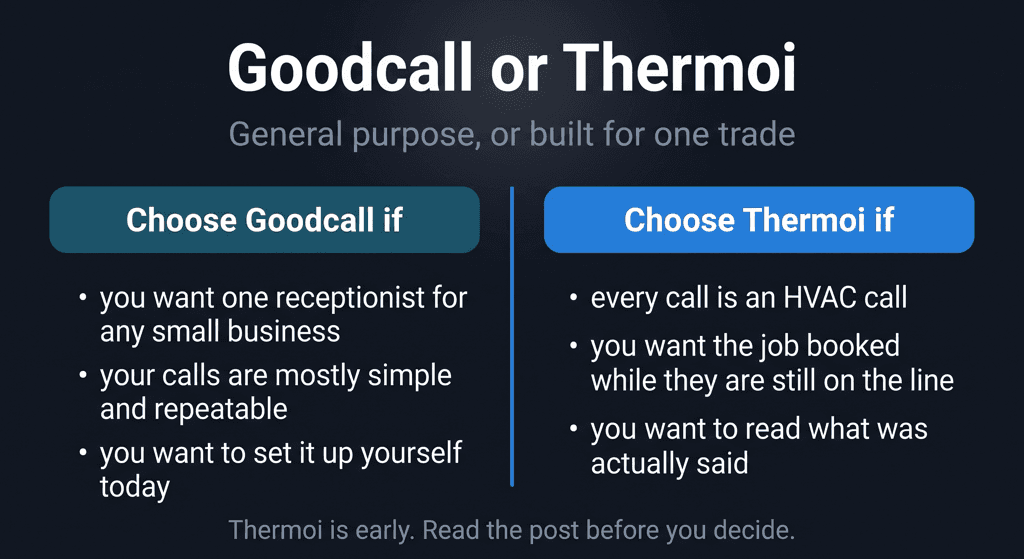
Thermoi's first month is free for up to 40 calls, with no card and no contract. It runs on your real phone line, so you see every call written up with a full transcript and the caller's own description of the problem. At day 30 you get a report of calls answered and appointments booked, with the transcript of every call. A month of real calls shows you how many emergencies came in after hours and how quickly you got back to them. From there you either pay $299 for month two or let it end, owing nothing. The plan is $299 a month for up to 200 calls.