Missed calls do not all cost the same.
A homeowner asking what a spring tune-up costs gets voicemail. That is a lost lead, and it is annoying, but they might call back or find you online later.
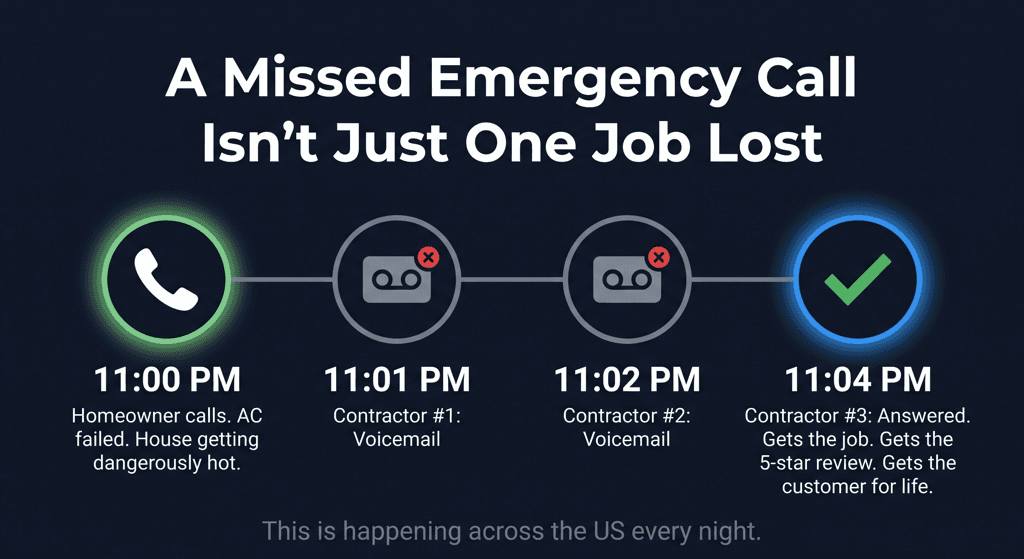
A homeowner whose heat stops at 11pm in January, with an elderly parent in the house, gets voicemail. They are not calling back tomorrow. They are calling the next contractor right now.
That is the real cost of a missed emergency call, and the job itself is only the first part of it.
What happens when an emergency call goes unanswered
A homeowner in a real emergency follows a predictable path.
They call the first contractor they find, usually the top of a Google search or the number on last year's invoice. If it goes to voicemail, they do not leave a message and wait. They call the next number, and if that goes to voicemail too, they call a third.
Whoever answers gets the job, at whatever price. The other two never find out they lost it.
This is the thing to understand about emergency calls: the window for the job is measured in minutes. By the time you return an 11pm voicemail the next morning, the homeowner has booked someone else and the problem is being fixed.
The missed call cost you a service visit, and it handed a competitor a new customer.
The job itself
An emergency call is real money. Depending on the problem and the market, an emergency repair visit typically runs $200 to $600. A replacement that starts with an emergency visit runs $5,000 to $15,000. Many shops also charge an after-hours rate on top.
In Phoenix during a July heat wave, an after-hours call about a dead AC is one of the most valuable calls an HVAC shop gets. A family worried about the heat is not going to haggle over the after-hours rate. They want it fixed.
That is the job you lose when the call goes unanswered.
The customer you didn't get
The job is only part of it. The bigger number, and the harder one to see, is everything that customer would have brought you afterwards.
A homeowner who has a good emergency experience tends to stay with that contractor: the maintenance plan, the seasonal tune-ups, the replacement when the system ages out, and the recommendations to family and neighbours. Add those up over five years and a single household is worth many times the first visit.
When a competitor answers that 11pm call and does good work, they get the $400 visit, then next spring's maintenance plan, then the replacement quote a few years on, then the call from the homeowner's brother-in-law whose AC has started making a strange noise.
All of that started with a call you missed.
Why emergencies arrive when you can least answer
Emergency calls tend to arrive exactly when your phone coverage is thinnest.
Systems fail under strain: the first big heat of summer, a January cold snap, an unusual weather week. Those are the same weeks your techs are already booked solid and whoever answers the office phone is buried in routine calls.
Evenings are often the worst. A system that has struggled all day can give out after dinner, when the house is full and the outside temperature is still high. A family that put up with a weak AC on a 105-degree afternoon reaches the end of their patience at 8pm.
That 7pm Friday call in a Phoenix heat wave is both one of your most valuable calls and one of the most likely to hit voicemail.
The cost that never shows on a spreadsheet
There is a third cost that contractors almost never count: the review.
Sometimes a homeowner who called in a panic, got voicemail, rang two more shops and finally got someone out at midnight comes back to the first contractor's listing and says so. Something like "Called at 9pm when our AC died, went to voicemail, had to find someone else." That review sits on your Google listing, where every future emergency searcher can read it.
The shop that answered gets the other kind: a family that was taken care of on a bad night and tells people about it. A review like "our AC died at 10pm and they picked up and had someone out within the hour" brings in the next few calls on its own.
What the fix looks like
For most small shops, hiring overnight staff does not add up. You would be paying a full salary to cover hours that bring in a small share of your calls.
The practical fix is something that answers every call at any hour, writes down what the caller is dealing with in their own words, and puts it in front of you instead of leaving it in a voicemail box until morning.
That is what Sara, Thermoi's AI receptionist, does. When a homeowner calls at 11pm, Sara asks what the system is doing and writes down the answer the way they say it: "no AC," "no heat." She takes the service address and the callback number, and if they want a visit, the day and part of the day that suits them.
The homeowner reaches someone instead of a beep, and hears that their details are noted for your team. You get the whole call as a summary and full transcript, so you decide who goes first and when to call back. A simple morning routine for the overnight calls makes that part faster.
Answering is what separates losing a $400 emergency job, and the five years of work that follow it, from winning both.
A simple test
Think about tonight in your market: three families in Phoenix or Houston, or wherever you work, with failed AC on a hot evening, calling contractors.
How many of those calls would you answer? How many would go to voicemail? How many would end up with whoever happened to pick up?
If you can't answer that with confidence, that is the problem. The quickest way to find out is to run Thermoi free for a month, up to 40 calls, with no card and no contract. It answers your real line and you get full transcripts, so you can read every call that came in overnight. At day 30 you get a report of calls answered and appointments booked, with the transcript of every call, and you either pay $299 for month two or let it end, owing nothing.